As generative AI accelerates software development, it is simultaneously equipping attackers with the ability to discover and exploit zero-day vulnerabilities in minutes. Traditional deterministic security playbooks and prioritized alerts are no longer sufficient when an autonomous AI agent can relentlessly test every node in a target environment. To survive the machine speed of modern attacks, security teams must stop merely prioritizing vulnerabilities and start deploying agentic workflows to mitigate and remediate threats autonomously.
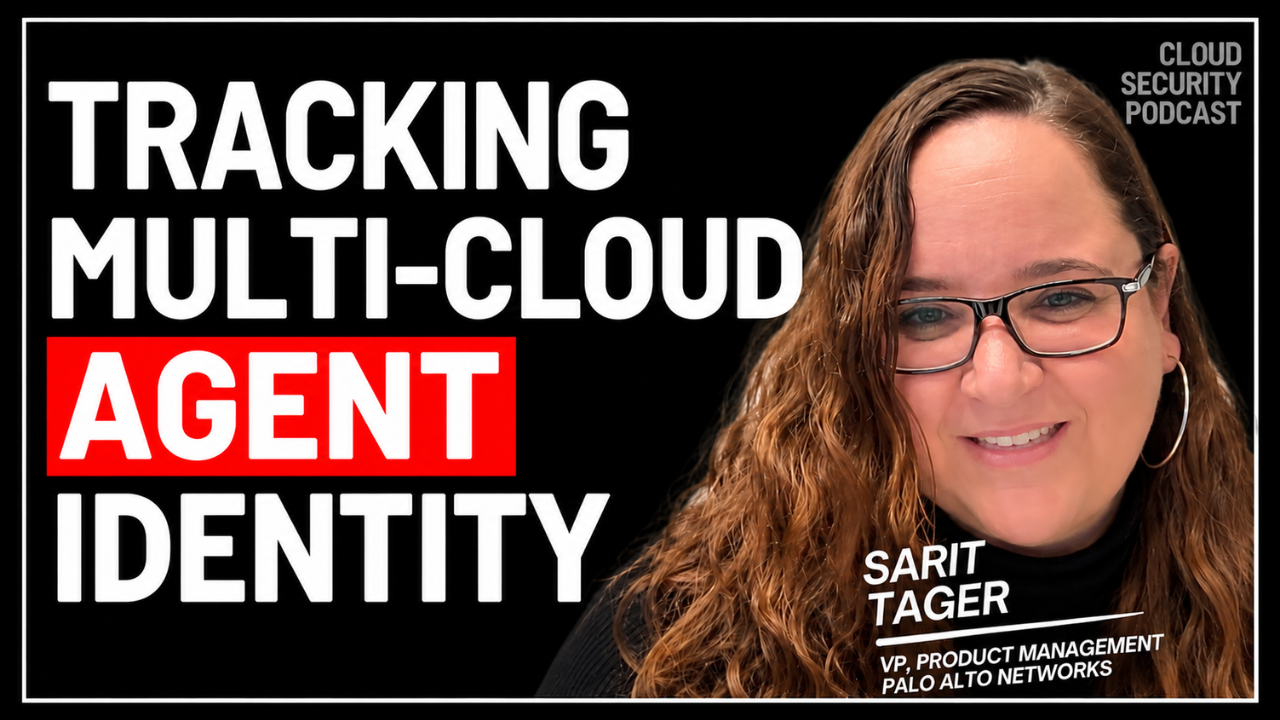
In this episode of the Cloud Security Podcast, Ashish sits down with Sarit Tager, VP of Product Management for Cortex Cloud at Palo Alto Networks, to discuss the findings from the 2026 State of Cloud Security Report. Sarit unpacks the growing crisis of "Shadow AI" in the cloud, noting that 40% of surveyed organizations cannot even reconstruct the actions taken by their own AI agents. We explore the complex web of non-human identities, the shift from reactive incident response to proactive agentic mitigation, and why the line between CloudSec, AppSec, and SOC operations has completely dissolved.
Questions asked:
00:00 Introduction to AI Agents and Cloud Security
02:30 Sarit Tager’s Background and Shift from Engineering to Cloud Security
03:50 The Complexity of Deploying Agents and Managing Shadow AI
06:30 Why 73% of Organizations Give Agents Permissions to Modify Pipelines
08:50 The Challenge of Tracking Multi-Identity AI Agents
10:30 Why Deterministic Threat Hunting Fails Against AI Attackers
12:30 The Difference Between Traditional Automation and Agentic Workflows
15:30 The Nuance of Shadow AI: Endpoints vs. Cloud Workloads
18:50 Why 40% of Organizations Cannot Reconstruct AI Agent Actions
25:30 How Attackers Use Frontier Models to Find Pre-CVE Vulnerabilities
29:30 Shifting from Vulnerability Prioritization to Autonomous Mitigation
33:30 The Dissolution of CloudSec, AppSec, and SOC Silos
36:30 Palo Alto Networks' Vision for Agentic Cloud Security Workforces
[00:00:00] Sarit Tager: Between discovery and exploitation, it's like minutes
[00:00:02] Ashish Rajan: 40% of the respondents were not able to reconstruct their AI agent actions.
[00:00:07] Sarit Tager: Exactly. It will be an agent that will try everything. I think agents will not let us be reactive. You have to act upon a problem, and in a way, you have to fight AI with AI.
And in the last few months, the new hobby of attackers became to create malicious packages. Now we see a lot of hackers trying to just run from GenAI models on an open source component- Yeah ... and just find vulnerabilities, and then you don't even have the CVE yet, but you have to be protected. I didn't see yet an identity change, but it will come.
[00:00:37] Ashish Rajan: I'm 99% sure if you're listening and watching an episode of Cloud Security Podcast, or even AI Security Podcast, you probably use AI agent in some form. You may have a different definition of what an AI agent may be to me and perhaps to other colleagues in the industry as well. But one thing is for sure, a lot of us are still trying to unpack what does it look like when an AI agent has started a security incident.
Possibly because it was not created with the intent [00:01:00] of doing malicious actions, but what that meant for security is that when we look at incidents, we're able to quickly identify if we see a technical error message or like a spike in traffic. But what we are not able to identify is the intent or are we running shadow AI in our cloud.
And to have this conversation, I spoke with Sarit Tiger. She's a VP of Product Management for Cortex Cloud in Palo Alto Networks. They recently released a report on State of Cloud Security, the 2026 edition. And I want to understand, A, how are people responding to AI agents in a cloud environment? Based on all the work that they do with their enterprise clients?
So if understanding what the state of cloud security is looking like in a world of AI, and how different industry misconfiguration and prioritization, which is in certain ways the older way of doing things, the pre-AI world. And if you know a friend or a colleague who's trying to understand or work in a similar space, definitely share this episode with them as well.
As always, if you're here for a second or third time and have been enjoying the episode of the podcast, thank you so much for all the love and support, and I would really appreciate if you take a quick [00:02:00] second to hit the subscribe or follow button, whichever podcast platform you may be listening or watching this on.
We are on all podcast platforms, including Apple, Spotify, YouTube, LinkedIn, and wherever you consume your podcast from. I hope you enjoy this episode with Sarit. And also a shout-out to Palo Alto Networks for sponsoring this episode of the podcast. Enjoy the episode. Talk to you soon. Hello and welcome to another episode of the podcast.
We've got Sarit with me, our return guest as well. Thanks for coming on the show again, Sarit.
[00:02:25] Sarit Tager: Thank you. Thank you, Ashish, for having me.
[00:02:27] Ashish Rajan: Maybe people who may not have heard the first episode, we should probably start with just a bit of a general introduction about your professional background, so before we get into the conversation.
[00:02:35] Sarit Tager: Yeah. So I'm Sarit Tager. I'm leading the Cortex Cloud and Exposure Management in Palo Alto Networks. I joined Palo Alto Networks about three years ago. I started from the application security and then moved into the cloud. In background, I did a lot of product positions, but one of the fun facts is that I was a VP of engineering, so I know all of this from firsthand how developers need to handle security issues or think are fast from [00:03:00] production-- going to production.
I feel that kind of the vibe coding did something for me that is coming back, to my origins. It's a very exciting time.
[00:03:08] Ashish Rajan: Last time we definitely go- went into the developer background that you had as well, because you ha- we spoke about AppSec, CloudSec.
Today, we're talking about agent security as well. Maybe just to give some sense of... I think at this point in time, we don't have to explain what agent security is, but I feel like there's definitely parts of the conversation that people hear about agent security in the industry that could be wrong, and perhaps some s- specific controls that they don't even realize they're missing which makes it wrong.
I'm curious in terms of A, do you see anything which is missing at the moment in the agent security conversation that people are having? Or you guys talk to Fortune 500 global 2000 companies as well. What are you seeing in the customers you're talking to about where do people miss or miss the message be- behind agent security?
[00:03:54] Sarit Tager: So I would say it's quite wide in a way, right? First I think- Customers mostly, in [00:04:00] most cases, try to maximize velocity and- ... not necessarily security. 'Cause there is a huge effort to make sure that you progress very fast, that you produce your products. And sometimes there is some kind of a miss on the security part.
Like, how do I really deploy agents securely within my cloud environment, within my endpoints? It's also very difficult because you have different agents doing different things.
Most of the cases we see agent being used for a code, for example, like for coding agents.
But then they are also being used on their pipeline, on your cloud, like for doing bunch of different tasks. So I think deployment is super complicated in sense of where agent are actually being deployed. The second one is that there is a lot of shadow AI. There are a lot of things that you don't necessarily know.
You have skills and MCPs and like agent running with different RNs, and if they have like different models. So all of these things are not necessarily being [00:05:00] visible today by the current systems. And one thing that I heard from several CISOs sometimes people think that identity, like for agent, is if you're using your identity or if you're using a service account, then everything is okay.
But the only part they are missing is that an attacker will try, I don't know, three times, and then it will fail. It will not try-- it will try a different thing.
For an agent, it will be something that will continue to try and, and attack the system. And even if you potentially have an identity which has a risk, when it's let's say a human attacker or someone that tries to attack you, which is not an agent, it may be less risky than an agent.
I think the entire way of everyone is talking about the agent security. In my perspective, it's everything security, 'cause you have agents everywhere. You have your chatbots, and you have the agents that do your analysis, and you have agents that are running on your mail. So basically, it's changed the infrastructure [00:06:00] we are living o- off, right?
It's not just about let's do an agent security. Let's just make sure that the system still work when agents- Yeah ... are around.
[00:06:08] Ashish Rajan: I think I was reading through the State of Cloud Security report that you guys worked on. I think you had thousands of people I guess give survey was filled out by.
'Cause I think I noticed something over there as well where in the 99% of the organizations that have given either semi-autonomous or autonomous actions there, where I think 73% granted permissions to modify code pipelines, configurations. So it was actual write actions, not just read actions.
[00:06:33] Sarit Tager: Exactly.
And they change-- people sometimes don't understand, it's not about like even for like code, right?
[00:06:39] Ashish Rajan: Yeah.
[00:06:39] Sarit Tager: We used to talk about CVEs and like open source, and this was the I would say the regular supply chain. But now you can see changes that are being done on things like potential, cVEs or now emerging vulnerabilities or zero days malicious packages, potential malicious activities. Or, the code may be secure, but [00:07:00] it's trying to do something malicious. So I think if we look at it also the kind of the things that we need to find are wider than it used to be,
[00:07:08] Ashish Rajan: yeah. A- and I think another observation, because we're talking about cloud security here as well, another observation that I noticed, and I'm keen to know some deeper insight on the whole, are these AI agents, whether it's autonomous or even AI for that matter, is it being used to maybe make changes in cloud as well, or is it just, to your point, SDLC and code?
[00:07:29] Sarit Tager: So I think currently we see a lot more on the SDLC side just because people think it's easier and it's like before production.
[00:07:37] Ashish Rajan: But,
[00:07:37] Sarit Tager: There are some we do see some customers, mostly the one that are more like technical and more like more advanced on their journey, that they l- let an agent do changes on their infrastructure, for example, right?
Do s- change to configuration. Yeah. I think because we see everything like being done on different levels, whether it's an infrastructure change or... [00:08:00] I didn't see yet an identity change, but it will come. Okay. But I do see a lot of configuration changes, on the, what we call the kind of the mi- the configuration of the infrastructure itself.
[00:08:11] Ashish Rajan: Yeah.
[00:08:12] Sarit Tager: Sometimes it is, like we do see a lot, which is not just a read one, it's also a write one, and I think there is a r- real appetite to try to do things fast, but not all current guardrails are really something that are ready for this.
[00:08:29] Ashish Rajan: Interesting. Good. And I'm glad you mentioned identity as well, 'cause-- So those changes that are being made into the cloud, are they like...
I know obviously the industry talks about NHI as non-human identity and everything.
Is that what's being observed, or is it actually a developer identity? What's seeing more customer-
[00:08:44] Sarit Tager: I had a very interesting discussion yesterday about identity and what a devir- what what will be the identity an agent will take.
So potentially, yes, it can be the, some kind of a service account or the identity of the machine. But think about I give an [00:09:00] agent my token for an external service.
And then he will use my token, right? Although potentially the agent-- agent does not necessarily have only one identity.
Depends on the action it, it creates.
[00:09:12] Ashish Rajan: Actually, you're right.
[00:09:12] Sarit Tager: And I think it's something that we do see customers... Again, they do it mostly on staging and development because they don't go to production and say, "Yeah, let's run agents." But I f- I don't feel identity is still something that is being considered as something need to be secured.
Everyone understand it's a problem, but not- Yeah ... necessarily, take the actions to make sure that it's being guarded in the right way.
[00:09:35] Ashish Rajan: I think you're right because most people, when they think about an agent action, they're thinking, "Oh, I, Ashish, the user, started an agent." They don't talk about the sub-agents and any other action or tool that it's talking to that may have its own identity, and now you have a web of identities rather than just an individual identity that many people just focus on, actually, what does it mean for incident set? 'Cause I think a lot of cloud security for a long time [00:10:00] has been you find a misconfiguration, you investigate. Now we are saying that the AI is changing misco- cloud configuration. We have identity as a challenge from the agents that are going here. What did, what do these things mean for the investigation that a typical cloud security or security incidents that happen?
[00:10:19] Sarit Tager: So I will give you an example on two things that we see. When you look for attacks, like you usually look for patterns, right? Yeah. This is the reason, like when we did when we do cloud security, we usually try to find kind of an attack path or things that make sense to be attacks. If you think about agents, it's much more it's less deterministic in a way, right?
You don't need to assume that an attacker will try a method. Yeah. It will be an agent that will try everything. If you can-- if you think about it as a graph-
[00:10:49] Ashish Rajan: Yeah ...
[00:10:50] Sarit Tager: it will try every path on the graph, right? It's not- Yeah ... a specific one that makes sense. As opposed to attacker that will have some kind of a pattern how we want to break into your environment, [00:11:00] an agent will just run and try.
And I think when we look at the-- when we look at even before the incidents, we need the... both incidents is also on the- ... on the posture side, we need to assume that it's not deterministic anymore, that we cannot assume the deterministic rules or threat hunting will help when there is an agent involved, because they will just try to do everything.
We just saw it on the, all the last latest latest kind of incidents, and the second thing I want to say about the incidents you said like you have an incident and then you investigate.
[00:11:32] Ashish Rajan: Yeah.
[00:11:32] Sarit Tager: I think agents will not let us be reactive. Like you have to You have to act upon a problem, and in a way you have to fight AI with AI and act agentics, in agentic way, right?
To be able to actually, if you see an incident, then try to see what you can mitigate immediately, and not just wait for a person, to look at an incident- Oh ... and say, "Ah, okay, so I have a problem." Because everything from, when something is being [00:12:00] discovered, between discovery and exploitation, it's like minutes.
[00:12:03] Ashish Rajan: Yeah.
[00:12:03] Sarit Tager: And we cannot rely on humans to do all the investigation be- between the incident and the actual exploitation. So this is another thing that kind of changed.
[00:12:15] Ashish Rajan: Actually, it's an interesting one, right? 'Cause I'm sure people who would read the State of Cloud Security Report, there's a mention of, and we spoke about this earlier as well, that 99% people are already adopting agents.
I'm curious in terms of what is the difference? You, because you mentioned an incident could have... It c- doesn't, can't be just a deterministic rule. It has to... Can't be reactive. You have to be agentic. A lot of people almost question what's the difference between agentic and automation in this context?
And I guess y- feel free to throw in multiple cloud as well, because most enterprises today, never had only one cloud. So what's the difference so that people understand? 'Cause obviously you're talking to a lot of people who are actually doing it. So I'm curious for people who probably not seeing enough of it, what is the difference between automation and a agentic response?
[00:12:59] Sarit Tager: So [00:13:00] I'll say two things. Automation is something that you plan- Yeah ... and then you do for a scenario, right? That you know. For example if A and B and C happen, then let's do D, for example.
[00:13:11] Ashish Rajan: Yeah.
[00:13:12] Sarit Tager: When I'm talking about agentic workflows in a way they need to respond to different path. And it's not ne- necessarily something they saw in the past.
They have like their, the ability to react to different things. And the other thing I would say on this one is also that there is an assumption that there are some things you will do, like the agent will do, the one that doing the agentic workflows will do without an approval, right?
Yeah. Like it will be autom- it will be automatically, and some of it will require an approval. It's a bit of a different workflow than let-- just do the automation and complete your task.
[00:13:48] Ashish Rajan: Yeah.
[00:13:49] Sarit Tager: Rather than it more, it will be more interactive if I try to do something that is, has some risk.
[00:13:55] Ashish Rajan: To your point, based on your risk, you could already have a, quote-unquote [00:14:00] action that could be taken by the agent-
[00:14:01] Sarit Tager: Yes ...
[00:14:02] Ashish Rajan: versus oh, I've now s- I see a S3 bucket is open to the internet. Let me start my automation, and let me figure out what's gonna happen," or what is an error message or whatever.
You're I guess what you're trying... I guess what you are saying, it should not matter what the scenario is. It should be able to understand the action it should take.
[00:14:18] Sarit Tager: Exactly. And whether the action will solve it, right? It needs s- in a way, it needs to simulate. It's something that usually when you work with automation does not,
in most cases, will not go back and try to figure out if things were solved. Yeah. From a general workflow I s- I, this is part of the things I s- I assume an, an agent will have to do.
And to your point you said before people say that they are using a agent. I feel like agent is such a broad, Oh, yeah
Of a term that Some people think that talking with a chatbot is an agent. Is an agent
[00:14:50] Ashish Rajan: as well, yes.
[00:14:52] Sarit Tager: And it's not the same. I'm not talking about, I'm not saying it's not g- good, and sometimes you do want to talk with the chat. But the idea is that the agent will actually do f- things for you, that it [00:15:00] will investigate, it will solve things and it will be autonomous, not in the sense of I will ask a question and then I will get an answer.
And I think, I was surprised seeing that people say, "Yeah, about 10, 90% using." I was thinking, "Yeah, well-" "... probably more on how you interact with agent as a chat and as an additional information, as a enrichment of your data." To your point from the beginning, mostly in read- Yeah ... rather than write.
[00:15:28] Ashish Rajan: Yeah. And I guess it kinda goes back to, because all of us have been cloud for a while, it goes back to when people would say, "Are you using cloud?" People will say, "Yeah, I use cloud." But they would be using like Salesforce. Yeah. And you're like, "Eh, it's not the cloud I was referring to, but I hear
[00:15:42] Sarit Tager: you." No, they use cloud or they lift and shift from their on-prem environment and just use VMs and didn't use any like, scala.
Like they didn't use the cloud kind of capabilities. And I feel in some cases-- And again, there are customers that are much, much more advanced on their usage. Of course. Of course, yeah. But then they also understand [00:16:00] they need to put guardrails because otherwise, like the agents, they need definite boundaries on what the agent can do.
They dis- need to define in advance which type of identity it will use what type of information it can access like which type of boundaries we should block on, like what are the being done internally versus what can be go externally. It's actually made our life simpler- ...
[00:16:26] Ashish Rajan: but
[00:16:26] Sarit Tager: also security much more complex, if you think about it.
[00:16:31] Ashish Rajan: Yeah. Yeah. And I think talking more about incidents as well to what you said, even though it may... it feels like everyone's using agent and ma- it's made of our lives a bit more easier. I think incidents still, like we spoke about the identity piece earlier, and we-- W- what should be let's-- If we were to pick a scenario where I have AWS, Azure, GCP humans, agents that are all running at the moment, is there like an identity model that comes to mind that's probably [00:17:00] perhaps better for an agent?
'Cause I think you said earlier you had a few discussions about this as well. So I'm curious in the customer conversations, like what are identity models being used? I think people had some idea where it was AWS, Azure, GCP, let's use single sign-on federation, Bob's your uncle after. But now we have all these agents as well.
What's an identity model that you think of that works in that scenario? And are there, is there a nuance or a difference from what it was before to now?
[00:17:27] Sarit Tager: I think this is back to what I said about agent does not have one identity.
[00:17:31] Ashish Rajan: Yeah.
[00:17:32] Sarit Tager: And I think in cloud you do assume that you have a, either a service account or you have your own id- or like a human identity.
You can also think about identity being on a SaaS application, on a developer, and on the cloud it's the same pers- like same agent that I run from these different things.
So I think we are all, Obviously, we have to do it on all the big clouds as one one a model.
I think it will be much more complicated than just, going with the traditional [00:18:00] identity model, right? You will have to understand that an agent can have multiple identities. It will have to be-- Some of it will be, in a way, a non- a non-human, although all of it is non-human. But I would say some of it will be really non-human.
Some of it will be run as a human, but not the human itself, but, take his id-identity in a way.
And I think it's also important to... By the way, even the definition for what is an agent is something that how you model agent. Does an agent mean harness? Does it, does an agent mean harness and its skills?
That it's agent-- Like it's something that I think everyone is trying to figure out how to manage it, so you can actually manage your own identity. I think the best thing I can s- I can say now that you have to take all these different data points- Yeah ... and make sure that if you see identity you know exactly where it runs, whether it's like on a SaaS, on a cloud, on an agent, on a person.
Like this has to be like one identity.
[00:18:57] Ashish Rajan: I love this because also one o- one more thing that stood [00:19:00] out for me in the report was that I think the survey that you guys did, you found that 40% of the AI-- 40% of the, the respondents were not able to reconstruct their AI agent actions.
[00:19:12] Sarit Tager: Exactly.
[00:19:12] Ashish Rajan: And to me, that was like shocking. At the same time, it's oh, wow, so we have potentially introduced agents without much telemetry. And I guess to your point- Yeah ... maybe the definition of agent kind of get, gets a bit loose as well. So I'm curious as to what were some of the conversations around that, like in terms of being able to reconstruct an AI agent action for instance?
[00:19:32] Sarit Tager: So I think the, the main one will be like, what is an agent, right? When do I qualify as an agent? And it's always I will give an example. If you have an agent and now you decide to add one more skill-
[00:19:42] Ashish Rajan: Yeah ...
[00:19:42] Sarit Tager: is this the same agent or is it a new one? ... There's the definition of what the agent is doing is.
I think some of it is very philosophical in sense of- Yeah. ... what are, what is an agent. And I think one of the things that is important in sense of how we look at it [00:20:00] in, in, as an, on an agent will be can we figure out what was the last things an agent did? And for this, we need everything we have today.
Like we have to monitor all the outbound communication. We have the traffic, all the in, all the inbound commu- communication. The one on the environment itself. Like you-- Like log size become Even more important than it was before, right? Because-
[00:20:25] Ashish Rajan: Yeah ...
[00:20:25] Sarit Tager: we have to know how to analyze logs in in I would say in scale-
[00:20:29] Ashish Rajan: Yeah
[00:20:29] Sarit Tager: to make sure that you track everything. And it's everything from like traffic, APIs, like things like that. You have to make sure that you have it as a complete solution. I think tracking agent activity is still something that need to be figured out. Not in sense of going through all the logs or understanding what it doing, but understanding what an agent did.
[00:20:52] Ashish Rajan: Yeah. Yep. And I guess you-- To add to what you were saying earlier as well, I definitely find on a similar note where people [00:21:00] have tried making attempts at this, trying to get the telemetry and observability and everything else. And one more thing that I find confusing in the industry is that a lot of people talk about shadow AI in the context of when they generally talk about it, it sounds like it's on my laptop and what I'm using versus most enterprises that I've worked with and continue to work with, they're using some kind of a cloud deployment of it.
So when your report called out the fact that there were, I think I can't remember the number of it, but essentially there were people who were even considering it. So what are examples of the kind of AI deployments and or an example of customer conversation you may have had around this, the whole shadow AI in the cloud context?
'Cause I feel like right now people think about more for laptop rather than anything else.
[00:21:45] Sarit Tager: Yeah. So here's the issue. I think in a way for laptops it's contained, right? You are-- You can scan the laptop and say, "Okay, this is all the, the things I see on the cloud."
[00:21:56] Ashish Rajan: Yeah.
[00:21:56] Sarit Tager: It's a bit more complicated, right?
I can wrap it [00:22:00] with a and cont- and run it on as a container. I can run it on serverless. I can run it on any different workloads. It's also a bit, I would say, distributed, right? The LLM itself can be external to the cloud. Yeah. I can have my own LLM. I can run SLMs, cer- like smaller models.
I think just from the scale of cloud and the fact that it's much more complicated than just going through your endpoint and understand what is being deployed there.
[00:22:26] Ashish Rajan: Yeah.
[00:22:26] Sarit Tager: It's just, I would say like people say "You ha- you need to have an AI security." I said, "No, you need to have a cloud security or an enterprise security," because AI just became the new infrastructure that we are all- Yeah
working on. So you have to elevate the way you do security. So I think shadow AI is something that people not necessarily yet understand how to look within the cloud.
[00:22:51] Ashish Rajan: Yeah.
[00:22:51] Sarit Tager: And going back to what I said, As long as your agent is just a read one, it's risky. But if you try to give, if you give him [00:23:00] like you give him some identity that can also write, then you get into a problems 'cause you don't ne-necessarily understand what was done.
It's also not predictable. So I think visibility is a key part, making sure you have the guard r- the gu- the right guardrails, making sure you can block any attacks coming from the outside. Like this is a very important steps to make sure that you have a good security.
[00:23:21] Ashish Rajan: Do you feel people should actually the whole AI agent actions as a whole with whether it's on the right AI or whether it's on the right service.
You could even has a... 'Cause a lot of companies in that enterprise layer have regulations that they have to follow, so they may not want an agent. Even though S3 bucket is allowed in the US region, it should not be used in the European region. There could be so many layers to even how an agent operates.
Is there a, I don't know, a mental model that you guys had in your conversation or in the report that people could use to-- Like, should an agent be grading their own work?
[00:23:59] Sarit Tager: So-
[00:23:59] Ashish Rajan: I don't know. [00:24:00]
[00:24:00] Sarit Tager: So I would say two things w-which we saw. A generic agent will probably not work for most of the customers.
They will have to tweak them to what they need. Yeah. Which means by some organization knowledge. And the same goes for security, right? You will not be able to use security for the agents if you don't understand the organization. You don't understand what are the guardrails they need to deploy on their environment.
In a way, if we think about agents, I think the generic agents that we think will solve things will probably bring more risk and not necessarily will do what's needed. So I would say the context, the business context is very important when you activate agents, but w- also when you want to protect it, Yeah
against any activities.
[00:24:43] Ashish Rajan: Yeah. Do you-- It's an interesting one, right? 'Cause to your point i-it's at scale of an enterprise people are trying to build security programs on this on this very activity, but also on the other side, there is the whole the Mythos and the Daybreaks of the world as well that are increasing.
And you kinda mentioned this earlier [00:25:00] briefly along the lines of the vulnerabilities are only going to increase, and and I almost see in our conversation so far, the two parallel tracks we are going with. One is the adoption of AI agent is 99%, and on the other end sounds like the other side of the, the red team or the, the bad side of security is also adopt-adopting it, which is why now we have the Mythos and the Daybreaks and everything else almost challenging how many vulnerabilities that come out as well.
If you were to take a almost a vulnerability discovery and weaponization kind of a view what should people focus on? We spoke about agent and cloud so far, right? Most people from a cloud security background usually just look at misconfiguration as a thing. Yeah. They go, "Hey, cloud misconfiguration, top problem.
Now maybe I have some kind of an AWS Azure or AI service." That's not that different. It's just the same. I'm just curious, have you seen incidents also become different as these kind of things have happened? And obviously, you guys have the [00:26:00] whole Unit 42 and everything- ... as a research organization as well.
I'm curious as to what are you guys seeing in terms of how much has that changed as a whole world from We didn't speak that long ago. I almost feel like every month- ... that passes in AI is like there's a new evolution. Curious as to what does that look like now?
[00:26:17] Sarit Tager: I have two things to say on this one.
First, I always said I feel that the, in the last few months, the new hobby of attackers became to create malicious packages. I don't know. It seems - Yeah. Feels like it, yeah ... that's what they are doing, right? And I think this has become a real thing, right? Before that, if you think about malicious packages, yes, we had some, but it wasn't a focus areas.
Now we can-- you can bring them into your code, you can deploy them on your cloud environment, and now you have things that you don't understand how they will behave. The second one I would say is that we do see a lot of, I would call it, before vulnerabilities, right? Vulnerabilities or CVEs are something that you already know of- Yeah and you know exist within an open source. Now we see a lot of hackers [00:27:00] trying to just run this Mythos or this Frontier AI models on an open source component.
[00:27:05] Ashish Rajan: Yeah.
[00:27:06] Sarit Tager: And just find vulnerabilities. And then you don't even have the, the CVE yet, but you have to be protected, right? It's very different.
It's become very much not something deterministic and say, "Okay, this is a CVE. I patch it or mitigate it," or something like that. So I think in my perspective, there are three things that need to be in focus. The first one, try to solve as much as possible within the developer environment, right?
As much as possible to be blocked there. It's the less costly one, right? 'Cause it's developers... technically it's a coding agent, it's not developers, but then if you have an agent that do security and kind of interacts within the agents, it's-- this is something that need to be invested. The second one- You have to proactively test your environment.
Test, I mean from vulnerabilities. Try to attack it from the outside in a way using agents to try and attack it from the, the outside and t- try to simulate [00:28:00] what an attackers can do. And the reason I'm saying that is because you have to make sure that your environment is c- is ready even before you, b- before you actually get attacked.
And the last one, and the most important one, you have to have a very strong runtime agent, right? And s- And sensor that actually blocks things from production. I think another thing I want to say on this one is that it's not necessarily that you can up- Let's say you found a new vulnerability within an image you are using on, on, on all your production.
Trying to upgrade it in these time frames is almost impossible, right? So you have to have also a mitigation in place, like trying to fix things or put s- signatures as a virtual patching on things like that. So I feel remediation and mitigation become a new thing. It's not a-- if you think about as you mentioned, we talked about cloud, everyone talk about misconfiguration.
I feel this kind of changed things to be more vulnerabilities or more like before b-before [00:29:00] CVEs or kind- Yeah ... of zero days, and then it's shifted from let's prioritize to let's just remediate or mitigate, 'cause it-- you have to respond.
[00:29:09] Ashish Rajan: Oh, so people are comfortable with auto remediation finally?
I'm like, it was, it's like it's been a sore subject of cloud security-
[00:29:15] Sarit Tager: Yeah ... for
[00:29:16] Ashish Rajan: a long time.
[00:29:16] Sarit Tager: They are more comfortable in auto remediation in the code, because this is where they feel anyway the code is being written by agents, so let's let them remediate. Oh,
[00:29:25] Ashish Rajan: yeah. Fair. Okay.
[00:29:26] Sarit Tager: I think they are more comfortable on the runtime for mitigation rather than remediation, like putting mitigation guardrails or compensating controls.
I didn't see yet, and I don't see I will see it very very in, in the next future, someone with-- that said to the agent, "Yeah, you can change the image and now replace it with a good image." I didn't see it. I don't see, I don't think it will be happen that fast. But I think people are trying to, customers are trying to see how they can react fast-faster to problems, and usually it goes into mitigation rather than let's just re- change the image or something like that.
[00:29:59] Ashish Rajan: I love this [00:30:00] also because looking into the future, people who are perhaps traditionally were building cloud security programs, they're looking at this from a cloud security lens. There are appsec people looking from an appsec lens. There's the governance people.
The list go, goes on, and I think you said this in the beginning where AI is across the board, not just in a, not just your laptop anymore. So wi-with that in mind what's the difference in, how should people look at their organizations moving forward, and specifically security teams in it?
'Cause I almost feel whereas, Jan, what you're saying is like there's a lot of overlap now. It's not the same pe- I just can't be a cloud security person anymore. I have to be- Yeah ... multifaceted.
[00:30:39] Sarit Tager: Correct, and I think this is very important. I feel the boundaries has changed a bit. The, it's blurred between the different if you have an application security or cloud tech, or even a SOC, right?-
Yeah ... running the incidents. Because AI is changing, it kind of blurs the roles if you think about it. You can do agent that can do a lot of things. If you ju-just [00:31:00] do, if you just build your program with misconfiguration, you probably will not get anywhere 'cause you will have a lot of all these vulnerabilities coming your way that will affect your cloud security eventually.
[00:31:09] Ashish Rajan: Yeah.
[00:31:10] Sarit Tager: If you don't care about preventing in, In the code area or in the SDLC, then you will find yourself in a case where your cloud is being ex- exploded with problems. It used to be a very siloed one, but AI and agentic in general, because agent, by the way, don't have a role, right? Everyone can do- Oh, yeah.
I see. There's no like- Agent can do what... Agent can do can write a code but also can do something else in theory if you write it correctly, but without- Yes ... even write the RS. So- To the fact that you have to look at the program in much more realistic way.
[00:31:43] Ashish Rajan: Yeah.
[00:31:43] Sarit Tager: Doing just misconfigurations is not enough.
You have to make sure that you have a protection in place, so you have the right runtime sensors to block these attacks. Yep. You need to make sure that you have an access into your mitigation or compensating environment, so you will be able to, do a virtual patching because this will come your way.[00:32:00]
And then you have to make sure that your prevention of a program or the way that you want to make sure that things will not get into production will work correctly. I think that one of the things I had a discussion with the customer, like we used to u- talk a lot about prioritization in cloud.
Like, how do I do prioritization? I feel it's cha- it's changed to, let's make sure that funnel is not being growing, right? Yeah. Like they try to stop the funnel from actually being prioritized and then see how we do it, especially because you don't have time. You just don't have time between the actual thing.
I talked with a CISO a few weeks ago when we talked about, like we both were in the vulnerability area on, for the Log4j.
[00:32:40] Ashish Rajan: Oh, yeah.
[00:32:40] Sarit Tager: Log4Shell one. Yeah. And we said, yeah, it was once in a lifetime on Christmas. Like everyone was sitting and trying to figure out whether it's, they are affected or not.
And if you think about the last few weeks, like you see so many vulnerabilities, so many malicious packages, it's not like a one- once every year a... We used to call [00:33:00] it celebrity CVEs. Yeah. I feel there are a lot of celebrities now.
[00:33:04] Ashish Rajan: Yeah. Th- I feel like everyone's a celebrity now.
It's every day is celebrity every day. Every single day
[00:33:07] Sarit Tager: becomes celebrity. I think this is a change that we see a lot. Like customers understand they cannot have the same method of operation that it did on Log4j, and they have to make sure Log4Shell, and they have to make sure that they have something much more automatic-
yeah
to understand what is going on.
[00:33:23] Ashish Rajan: And I love the fact... So maybe then towards the final question then, i'm curious as to, for the CISOs that you've been talking to in enterprises, how are they looking at security programs for this world? 'Cause based on what you're saying as well, there's a lot of cross-functionality now.
It's no longer just I'm a cloud security specialist in my own snowflake," as much as I got it. So what's, how are people approaching their security programs for, let's just say, we're in November now, so 2027 what are people looking at their security program as?
[00:33:53] Sarit Tager: I think in the most cases will be that they understand it's cross programs that, than it used to be, right?
[00:33:59] Ashish Rajan: Yeah.
[00:33:59] Sarit Tager: We [00:34:00] need to make sure that they understand exactly what is coming their way from the external side, right? If you think about like exposure management and external attack surface, this used to be different people doing that, right?
[00:34:11] Ashish Rajan: Yeah.
[00:34:12] Sarit Tager: These people can actually under- understand whether you're exposed from the outside to some of these vulnerabilities.
And then it has to be a complete flow, like from external into even open the PR for fixing for the developer. I think what we see from CISO is that they understand they cannot live in silos, and they have to, connect all the dots, making sure... We talked about identity a lot in, in the beginning, so if you don't understand the identity of your agents, if you don't understand which identities you have on your environment, it's not enough to say, "Okay, let's-- I will be an identity person that would and I will handle only my stuff."
We feel-- We do see, I do see within the customers some kind of bearing on the actual actual you know, roles and response to, and response, and responsibility. They understand that it's not-- They cannot continue with these silos [00:35:00] of I don't care what is going on before production, and I don't care what is going on in production.
So this is mainly what I see with them.
[00:35:06] Ashish Rajan: Yeah ...
[00:35:06] Sarit Tager: and there is a lot of uncertainty. I don't think everything is clear yet, right?
[00:35:10] Ashish Rajan: Yeah. Yeah. I'm sure there's a Mythos 5. Wasn't there a Fable 5.2? There's a newer Mythos
[00:35:15] Sarit Tager: coming
[00:35:15] Ashish Rajan: out.
[00:35:16] Sarit Tager: Yeah. I remember someone told me something about agents and said, "Yes, I will probably adopt agents on one thing in about six months."
And I was thinking to myself I feel that in six months we will have something else. Not necessarily we'll be using agents.
[00:35:29] Ashish Rajan: Yeah.
[00:35:29] Sarit Tager: Yeah.
[00:35:30] Ashish Rajan: Every month it feels like there's something else depending on who you talk to as well. I'm curious, 'cause obviously you guys have done this report, but you guys have Unit 42 in your access as well in terms of the research you guys do.
How do you... w- what's the vision that you guys have for Palo Alto Networks with cloud security moving forward in 2027 for, And what kind of in... how are you thinking or approaching this ecosystem now that it's, to what you said, it's very cross-functional, very much on that ball of it's not, the playbook is not the [00:36:00] same anymore.
[00:36:00] Sarit Tager: No. So I feel the key part is the fact they bro- brought everything to the same platform, so we have all the data sources. And I think this is super important. We recently even brought the SaaS security into the same thing. We have the SOC and the cloud going into the same thing. We have the application security going into the same thing.
So in a way, we have all the data points. We can say now I can build a flow that will be across everything, right? Yeah. If I have vulnerability I found from the external source, like by our exposure management, that I can close the loop until the developer, if it's an application being done by the developer.
I think for me, this is the key part, doing a full flows on how you respond to incident. And the second part is that- I look at it as a new workforce, right? You need to w- b- build a workforce for the cloud. Yeah. You need to have different agents that know to interact autonomously and check things.
[00:36:55] Ashish Rajan: Yeah.
[00:36:55] Sarit Tager: And I think in a way, we are going much more into the proactive one, [00:37:00] right? We will do it. We'll fud- figure out what will be done from the external. We'll do the testing. We'll figure out what is going on the core side. We'll figure out what is going on in the cloud, and then create flows. And again, I think remediation is a key part.
I would say mitigation and remediation is a key part. Full flows, not just, just let's do just identity flow, which is not important enough in this, in these complicated attacks. Not deterministic attacks, and I think this is important. Not thinking... you talked about misconfiguration.
I feel that the current misconfiguration, even with the, like, attack path and the kind of toxic combinations, it's not enough in these days. You have to do a real threat hunting to understand whether you have problems within a cloud.
[00:37:42] Ashish Rajan: Yeah.
[00:37:43] Sarit Tager: Focus will be having everything we have on the platform, an agentic workflow, a workforce of agent that will work for you much more autonomous and much more action driven rather than let's just prioritize.
Super exciting thing.
[00:37:57] Ashish Rajan: So moving away from prioritization, it's more [00:38:00] about action.
[00:38:01] Sarit Tager: Yes. Yes.
[00:38:02] Ashish Rajan: So it sounds like a promising future. We can probably sounds like we can have another episode on this. But where can people find more about... Obviously, I'll leave the link for the State of Cloud Security Report in the show notes as well.
Where can people find more information about the state of the stuff that you guys are working on, and where can people connect with you as well?
[00:38:21] Sarit Tager: Yeah. So they can find me on LinkedIn, of course. They can find our report on our website, on the Palo Alto Networks web- website. And I'm always eager to talk with anyone about cloud and about the future of cloud and agents in general.
[00:38:33] Ashish Rajan: I look forward to, and also I'll put the link to your s- LinkedIn profile as, and the link to the State of Cloud Security as well. But thank you so much for coming on the show.
[00:38:42] Sarit Tager: Thank you very much.
[00:38:43] Ashish Rajan: Thanks everyone. Thank you for listening or watching this episode of Cloud Security Podcast. This was brought to you by techriot.io.
If you are enjoying episodes on cloud security, you can find more episodes like these on cloudsecuritypodcast.tv, our website, or on social media platforms like YouTube, LinkedIn, and Apple, [00:39:00] Spotify. In case you are interested in learning about AI security as well, do check out our sister podcast called AI Security Podcast, which is available on YouTube, LinkedIn, Spotify, Apple as well, where we talk to other CISOs and practitioners about what's the latest in the world of AI security.
Finally, if you are after a newsletter that just gives you top news and insight from all the experts we talk to at Cloud Security Podcast, you can check that out on cloudsecuritynewsletter.com. I'll see you next episode.
Peace.